
Blog
March 14, 2026
How Surge Arrestors Increase Network Uptime for Telecom Operators
Modern telecom infrastructure operates in an environment where uptime is directly tied to revenue, service-level agreements (SLAs), and customer trust. Wireless backhaul links, cellular base stations, fixed wireless access systems, distributed antenna systems, and remote telecom cabinets form an interconnected ecosystem that must function continuously. As 5G deployments expand and network densification accelerates, operators are placing more sensitive electronics in exposed, elevated, and geographically distributed environments.
One of the most persistent and costly threats to network uptime is surge-related damage. Lightning events, ground potential rise, switching transients, and utility disturbances can introduce destructive overvoltage conditions into telecom systems. These events often lead to equipment failures, degraded RF performance, repeated maintenance visits, and unplanned service interruptions. For operators tasked with maintaining high availability across large geographic footprints, effective surge mitigation becomes a foundational requirement for long-term reliability.
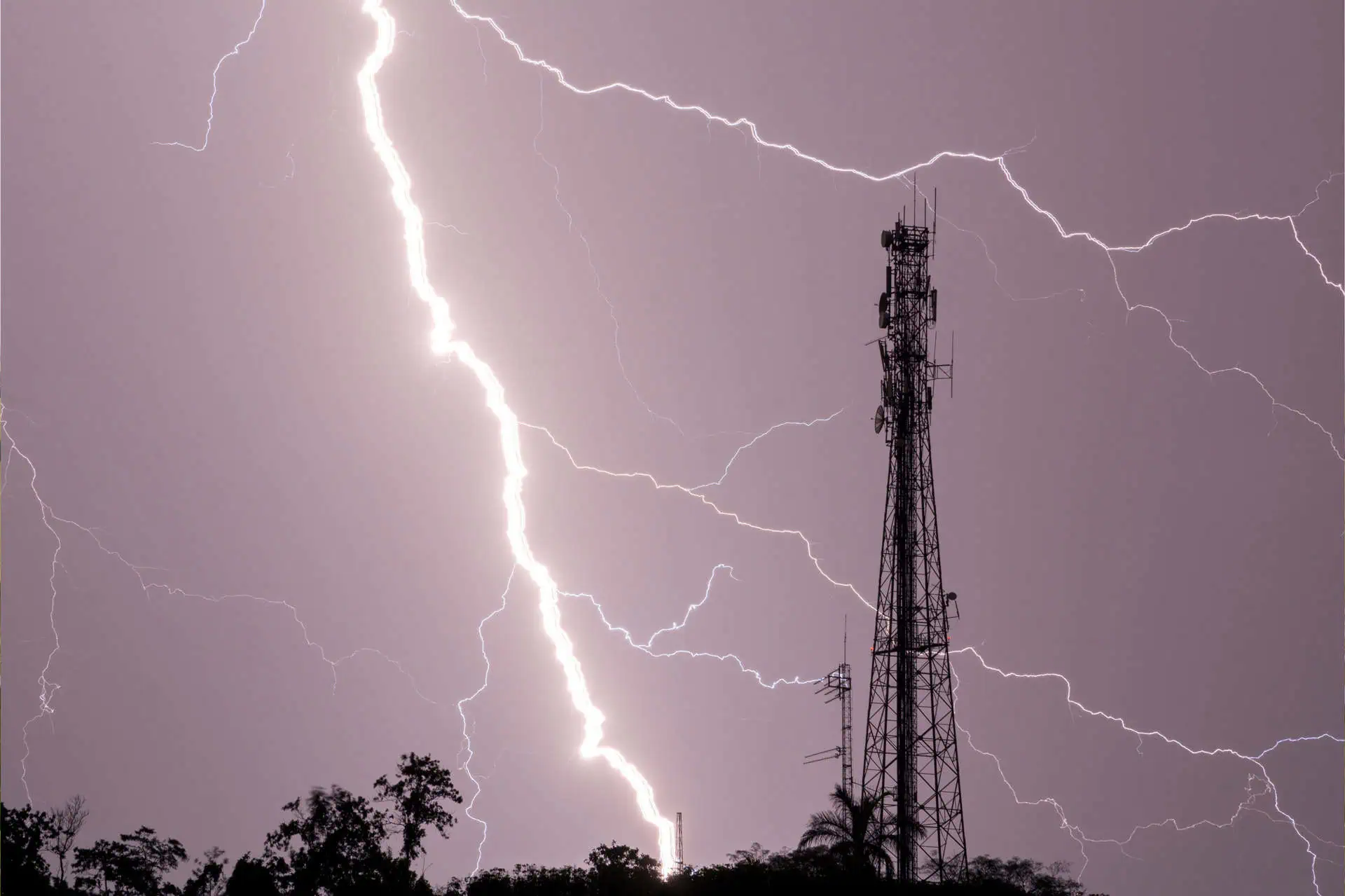
Why Surge Events Are a Major Threat to Telecom Networks
Telecom infrastructure is inherently exposed to electrical surges. Tower-mounted radios, rooftop antennas, outdoor enclosures, and long coaxial feed lines create natural pathways for transient energy. Even installations that are not directly struck by lightning can experience induced voltages from nearby storm events. In addition, switching events in power systems and fluctuations in utility distribution networks can generate damaging transient disturbances.
Common surge sources include:
- Direct lightning strikes to towers or nearby structures
- Indirect lightning-induced electromagnetic coupling
- Ground potential rise during fault conditions
- Switching transients in AC or DC power systems
The operational consequences of these events extend beyond immediate hardware damage. Surge exposure can degrade RF components, shorten equipment lifespan, and cause intermittent performance issues that are difficult to diagnose. Repeated failures increase maintenance calls and jeopardize SLA commitments. In high-density 5G and wireless backhaul deployments, where margins for latency and signal integrity are tight, even small disruptions can cascade into broader service degradation.
Understanding Surge Propagation in Telecom Systems
Surge energy does not enter telecom systems through a single path. It can propagate along AC power feeds, DC supply lines, RF coaxial cables, control wiring, and even grounding conductors. Because telecom systems often span long distances and multiple enclosures, transient voltages can couple into sensitive electronics far from the initial surge source.
Coaxial feed lines present a particularly critical vulnerability. Elevated antennas act as collection points for electromagnetic energy, and even indirect lightning events can induce significant voltage on RF paths. Without proper protection, this energy can travel directly to radios, receivers, and other active electronics.
Effective surge mitigation therefore requires a system-level perspective. Protecting only the power input is insufficient. Surge protection must be implemented at multiple entry points — including RF interfaces and control lines — to prevent transient energy from reaching critical components.
Surge Arrestors: A Key Defense for Network Uptime
Surge arrestors are engineered to divert transient overvoltage events safely to ground before they reach sensitive circuitry. By providing a controlled, low-impedance path during surge conditions, these devices limit voltage exposure and reduce the likelihood of component failure.
The effectiveness of a surge arrestor depends on several technical characteristics:
- Response time — how quickly the device activates during a transient event
- Clamping voltage — the maximum voltage allowed to pass through to protected equipment
- Energy-handling capability — the amount of surge current the device can safely divert
When properly selected and installed, surge arrestors help protect radios, baseband units, remote radio heads, and associated electronics from catastrophic damage. Beyond immediate protection, they contribute to extended equipment life and reduced maintenance frequency. For telecom operators, this translates directly into improved uptime and lower operational expense.

Design Considerations for Telecom Surge Protection
Telecom deployments present unique environmental and mechanical challenges. Equipment is often installed in outdoor cabinets, on towers, or in rooftop environments exposed to wind, moisture, UV radiation, and temperature extremes. Surge protection devices must be capable of maintaining performance under these conditions.
Electrical compatibility is equally critical. Surge arrestors must be matched to the system’s operating voltage, frequency range, and power levels. In RF applications, low insertion loss is essential to preserve signal integrity, particularly in high-frequency 4G and 5G bands. A poorly selected device can introduce attenuation or mismatch that degrades network performance.
Grounding and bonding practices also play a decisive role in protection effectiveness. A surge arrestor can only divert energy efficiently if it is connected to a properly designed low-impedance ground system. Inadequate grounding can limit protection performance and reduce repeatability across installations. For this reason, surge mitigation should be considered part of a broader grounding and bonding strategy.
NexTek Surge Protection Solutions for Telecom Infrastructure
NexTek offers a portfolio of surge arrestors and protection solutions engineered specifically for wireless and telecom applications. These devices are designed to protect RF paths and power interfaces without compromising system performance.
Key features of NexTek solutions include:
- High surge current handling capability for lightning-prone environments
- Low insertion loss across relevant RF frequency bands
- Ruggedized construction suitable for outdoor and elevated installations
- Options supporting DC pass configurations for powered antennas and active devices
By focusing on both electrical performance and environmental durability, NexTek solutions help operators implement layered surge protection strategies tailored to real-world deployment conditions. Rather than addressing protection as a standalone component choice, NexTek supports system-level surge mitigation approaches that align with network availability objectives.
Protecting Uptime Starts with Surge Mitigation
Network uptime is not achieved solely through redundancy and monitoring. It begins with protecting infrastructure against the transient events that cause avoidable failures. Surge arrestors serve as a frontline defense, limiting the impact of lightning and electrical disturbances on critical telecom equipment.
By incorporating properly rated surge protection at power, RF, and control interfaces, telecom operators can reduce outage frequency, extend equipment life, and lower maintenance costs. In increasingly dense and performance-sensitive wireless networks, proactive surge mitigation is a strategic investment in reliability.
Explore NexTek surge protection solutions designed for wireless and telecom applications, or contact a NexTek engineer to discuss surge mitigation strategies tailored to your network architecture.
More Company News



Get A Free Quote
Or Call 978-486-0582