
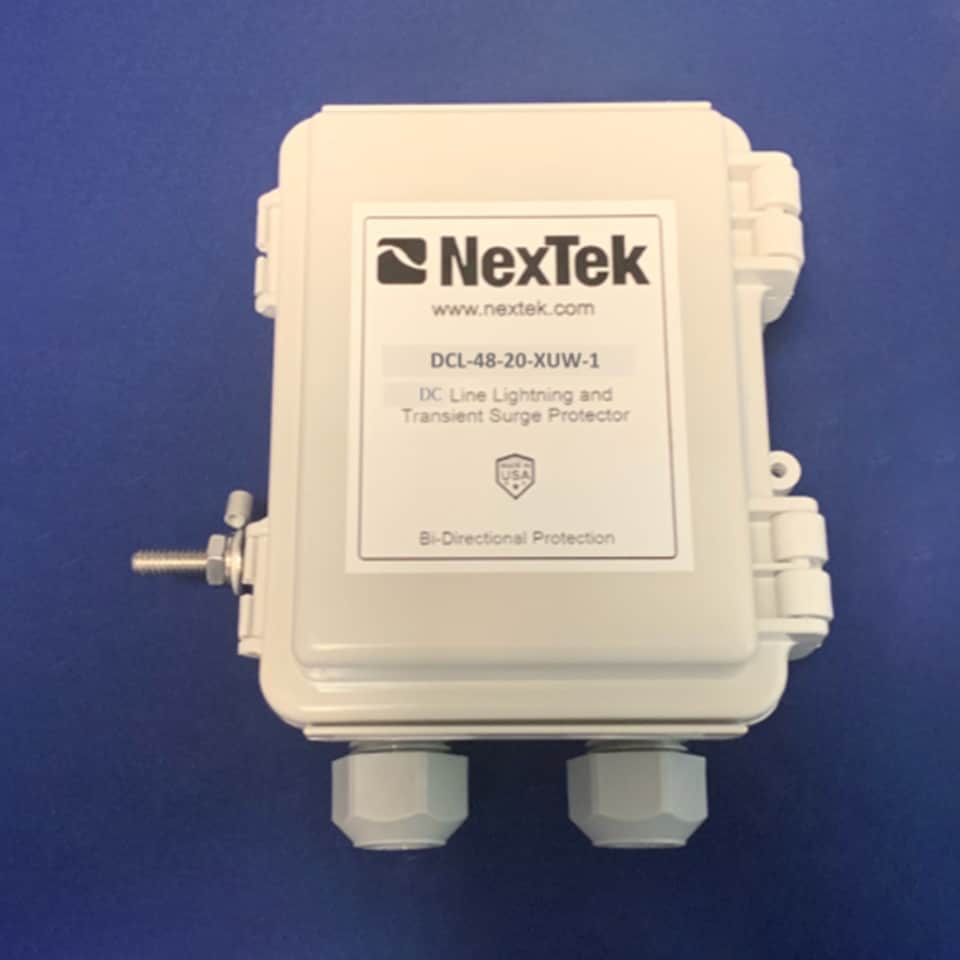
DC Line Filters for Lightning and Transient Surge Protection
NexTek DCL Series DC line surge protectors help protect electrical equipment from transient spikes and surges in direct current (DC) power applications.
These direct current line filters and surge suppressors provide DC overvoltage protection for systems that are regularly exposed to lightning-related events, transient voltage spikes, or electrical line surge conditions.
Standard DCL configurations are available for 12, 24, 48, and 60VDC applications, with custom solutions available for application-specific requirements. DCL options support indoor or outdoor installation and pole or panel mounting for DC-powered systems that require reliable surge protection.
What Is a DC Line Surge Protector and How Does It Protect DC Power Systems?
A DC line surge protector limits the voltage and energy that continue toward connected equipment when a transient event enters a direct current power line.
The transient event will drive voltage above normal operating conditions; the DC line surge protector is designed to respond when that voltage hits a defined threshold, helping to reduce the surge before it reaches downstream electronics.
DCL Series configurations use MOV protection for DC line surge suppression. In DCL configurations, protection applies to defined conductor paths, including line-to-ground and return-to-ground paths.
This approach helps protect DC-powered equipment from lightning-related transients, electrical line surges, and high input transient energy on DC power lines.
Applications for DCL DC Line Surge Protectors
DCL DC line surge protectors are well suited for industrial and commercial systems that rely on DC power at exposed equipment locations, remote installations, outdoor enclosures, or distributed infrastructure.
These devices support DC overvoltage protection at power entry points, panels, pole-mounted equipment, and equipment interfaces where surge energy may enter through the DC power path. Common applications include:
- Broadband wireless, Wi-Fi, telecom, and 4G/5G infrastructure
- Solar power and energy equipment
- Public safety and CCTV systems
- GPS/GNSS infrastructure
- Aerospace and aviation power systems
- Military, government, and homeland security systems
- Automotive and rugged mobile electronics
How to Select the Right DC Line Surge Protector for Your Power System
The right DC line surge protector is determined by a number of application details and operating conditions, including system voltage, current rating, surge exposure, installation environment, and protection requirements.
Designers should begin by evaluating:
- DC service voltage: Match the protector to the system’s DC voltage. Standard DCL configurations are available for 12, 24, 48, and 60VDC applications.
- Current rating: Confirm the current requirements of the protected DC power line.
- Surge protection requirements: Review surge current, multi-strike capability, and protection voltage values for the selected configuration.
- Protection paths: Confirm how surge protection applies across line, return, and ground paths in the DC system.
- Installation environment: Review whether the system requires indoor or outdoor installation, pole or panel mounting, and cable entrance sealing.
- Application-specific requirements: Determine whether a standard configuration is sufficient or whether the application requires a modified or custom solution.
For further assistance specifying a DCL configuration, contact NexTek with your project specifications.
DC Line Surge Protectors Recommended Products
NexTek offers DCL Series DC line surge protectors across standard service voltage configurations for DC-powered industrial and commercial applications.
- 12VDC configuration: DCL-12-20-XUW-1
- 24VDC configuration: DCL-24-20-XUW-1
- 48VDC configuration: DCL-48-20-XUW-1
- 60VDC configuration: DCL-60-20-XUW-1
All listed configurations are part of the DCLxx20XUW-1 product family. Available models vary by service voltage, breakdown voltage, and protection voltage, so engineers should review the relevant datasheet or contact NexTek to confirm the correct configuration for the application.
View NexTek Power and LAN/Data Surge Protection Product Families
Related Information on DC Line Filters
- Solutions for High-Altitude Electromagnetic Pulse (HEMP) Events (PDF): Review NexTek’s range of HEMP protection devices, including Level-1 DC line, AC line, and data line solutions, with HEMP testing options available on request.
- Get Grounded: Protecting Electrical Devices From Lightning Transients: Learn how bonding and grounding affect lightning protection performance, particularly when surge arrestors are used on AC power, DC power, RF/coaxial, or communication lines.
- Coaxial Lightning & Surge Protection: A Selection Guide (PDF): Use NexTek’s RF/coaxial surge protection guide to get arrestor technology comparisons, product family overviews, and practical selection questions for antenna-line and coaxial interfaces.
- GDT Lightning Arrestors – Transient Testing Details (PDF): Read about transient test behavior such as 8×20µs waveform testing, source/protector/load energy paths, and residual energy evaluation.
FAQs
Why do DC power systems require surge protection?
DC power systems require surge protection because transient spikes and overvoltage events can travel through DC power lines and threaten connected equipment. Lightning-related events, electrical line surges, and high input transient energy can create voltage stress at power inputs, making surge suppression an important design consideration for DC-powered industrial, commercial, telecom, energy, and outdoor systems.
What standard voltage ratings are available for DCL Series surge protectors?
Standard DCL Series configurations are available for 12, 24, 48, and 60VDC applications. These service voltage options give engineers a starting point for matching the protector to the DC power system. Because breakdown voltage and protection voltage vary by model, the selected configuration should be reviewed against the application’s operating voltage and surge protection requirements.
What is the difference between AC and DC surge protection?
AC surge protection is selected around alternating current power architecture, such as service voltage, phase configuration, and conductor paths like line, neutral, and ground. DC surge protection is selected around direct current service voltage, current rating, line/return paths, grounding approach, and the protection voltage requirements of the DC-powered equipment.
How do I choose the right DC surge protector?
Start by confirming the system’s DC service voltage, current rating, installation environment, surge exposure, and grounding approach. Next, review the protector’s surge current rating, multi-strike capability, breakdown voltage, protection voltage, mounting style, and environmental requirements. For DCL Series products, engineers should also determine whether a 12, 24, 48, or 60VDC standard configuration fits the application.
Can DCL surge protectors be customized?
Yes. Custom DCL solutions are available for applications that require modified DC line surge protection, voltage rating, installation approach, or other application-specific requirements. Contact NexTek with the system voltage, current requirements, installation environment, and surge protection goals to discuss standard, modified, or custom options.
Get A Free Quote
Or Call 978-486-0582