
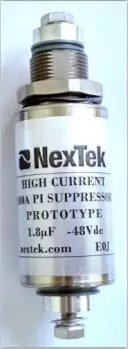
HCS High Current Pi Suppressors for Advanced EMI Protection
NexTek HCS Series high current Pi suppressors combine Pi-style EMI filtering with transient voltage protection for high-current power line applications.
The HCS Series uses a capacitor-inductor-capacitor (CLC) circuit with two stages of filtering separated by a series inductor. This Pi-style architecture supports maximum filtering performance at a lower frequency than a C-type filter of the same capacitance.
Unlike standard Pi filters, HCS suppressors add protection for switching reactive energy and externally produced transients. AC or DC voltage ratings are available to support a range of high-current electrical systems.
Connector Types
N/A
Frequency Range
- Current Rating – 180 Amps
Threat Types
- Rugged EMI filtering for high current lines
Design Highlights
- Extremely Compact Design – Great for Tight Packaging Requirements
- Rugged & Robust – Ideal for Extreme Environments
- High Performance – >60dB of Filtering to 1GHz+
What Are HCS High Current Pi Suppressors?
HCS high current Pi suppressors are feedthrough devices designed to address conducted noise and transient energy on high-current power lines. The Pi circuit attenuates unwanted noise, while the suppression components help manage transient energy on the power line.
This makes the HCS Series a strong fit when the application requires both EMI/RFI attenuation and transient protection in a compact high-current configuration.
Key HCS Series technical advantages include:
- Pi-style CLC filter circuit with two stages of filtering
- Diode-based suppression available for transient voltage protection
- Transient suppression added to the HCP-style Pi filtering approach
- AC or DC voltage ratings available
- Maximum filtering at minimum frequency, from 1kHz to >1GHz
- High capacitance options up to 22µF
- Compact, robust design for high-current power line applications
Applications for HCS High Current EMI Filters
HCS high current EMI filters are well-suited for systems where high-current power lines must address both conducted noise and transient exposure. These applications may involve switching reactive energy, externally generated transients, power quality concerns, or emissions and susceptibility compliance requirements.
Typical applications include:
- Medical equipment and imaging systems
- Industrial laser systems
- Telecom and cellular supply filtering
- Wireless power and communications systems
- Rugged mobile electronics
- Aerospace and aviation power filtering
- Automotive and EV power systems
- Energy and power control systems
How to Select the Right HCS High Current Pi Suppressor
The right HCS high current Pi suppressor depends on the system’s conducted noise profile, transient exposure, voltage rating, and mechanical requirements. Engineers should evaluate whether the application needs EMI/RFI attenuation only, or whether transient voltage protection is also required on the same power line.
Key selection factors include:
- Transient protection needs: Determine whether switching reactive energy, external transients, or transient voltage events must be addressed.
- AC or DC voltage rating: Confirm the required voltage type and rating for the power system.
- Capacitance and filtering performance: Select capacitance based on the required attenuation and noise frequency range.
- Current and power-line requirements: Match the suppressor configuration to the high-current electrical path being protected.
- Mechanical fit: Review package size, mounting, grounding, and enclosure constraints before selecting a configuration.
- Application-specific requirements: Confirm any environmental, compliance, or customer-specific needs before finalizing the part number.
If noise attenuation alone does not address the full electrical threat, an HCS Pi suppressor may be a better fit than a standard EMI filter, because it pairs Pi-style filtering with added suppression capability.
HCS High Current Pi Suppressors Recommended Products
NexTek offers HCS180 Series configurations across multiple capacitance values to support high-current Pi suppression requirements in power line applications.
- 0.01µF lower-capacitance configuration | HCS1801003Z10
- 0.10µF configuration | HCS1801004Z10
- 0.22µF configuration | HCS1802204Z10
- 0.47µF higher-capacitance configuration | HCS1804704Z10
View the HCS180 Series datasheet here.
All listed configurations are 180A, 100VDC high current Pi suppressor/filter products. Because filtering performance varies by configuration, capacitance is the clearest way to compare these models.
Review the appropriate product information or contact NexTek to confirm the right capacitance, voltage rating, suppression requirements, and series configuration for your application.
Related Information on HCS High Current Pi Suppressors
- EMC/EMI Filters Catalog (PDF): Explore NexTek EMI/EMC filter product families, including HCP and HCS Pi filter/suppressor configurations, custom filter capabilities, typical applications, and quality and manufacturing standards.
- Pi Filter Datasheets Now Available: Learn more about NexTek CLC Pi filter designs, including standard Pi filter configurations and options with integrated transient suppression.
- Using C-Type and Pi-Type EMI Filters for MIL-STD-461G, CS116 Compliance: Review how C-type and Pi filters can support MIL-STD-461 CS116 transient requirements on power lines when integrated into an overall EMI/transient-compliant design.
- Are Compact Form Factors Important when Selecting an EMI Filter?: Review why compact form factor can be an important consideration when selecting EMI/RFI filters for space-constrained systems.
FAQs
What is a Pi suppressor?
A Pi suppressor is a Pi-style filter configuration that combines EMI/RFI filtering with transient voltage suppression. The NexTek HCS Series uses a C-L-C filter structure with added suppression components to help address both conducted noise and transient energy on high-current power lines.
Can HCS filters be customized?
Yes. NexTek can design, engineer, and manufacture custom EMI filters to meet specific application requirements, including frequency range, current rating, voltage rating, capacitance, operating temperature, mounting configuration, and applicable test or compliance needs. If a standard HCS configuration does not fully align with your system, contact NexTek to discuss modified or custom options.
What is the difference between EMI and EMC?
EMI, or electromagnetic interference, refers to unwanted electrical noise that can disrupt equipment performance. EMC, or electromagnetic compatibility, refers to a system’s ability to operate properly in its electromagnetic environment without causing or being affected by excessive interference.
When should I use a high-current Pi suppressor?
A high-current Pi suppressor should be considered when the application requires both EMI/RFI attenuation and transient voltage protection on a high-current power line. HCS suppressors are especially useful when switching reactive energy, externally generated transients, or susceptibility concerns must be addressed in addition to conducted noise.
What is the difference between a Pi suppressor and a standard EMI filter?
A standard EMI filter is primarily used to attenuate unwanted electrical noise. A Pi suppressor adds transient voltage suppression to the filtering function, helping address both noise attenuation and transient energy in applications where filtering alone does not cover the full electrical threat.
Get A Free Quote
Or Call 978-486-0582