
Blog
March 15, 2026
Safeguarding Precision: Essential Surge Protection for High-Accuracy GPS/GNSS
High-precision Global Navigation Satellite Systems (GNSS) are engineered to deliver centimeter-level accuracy in environments where small errors carry real consequences. In precision agriculture, construction, surveying, and infrastructure timing, even minor positional drift can disrupt workflows and erode confidence in critical systems.
Unlike standard GPS receivers, high-precision GNSS modules rely on correction techniques such as Real-Time Kinematic (RTK) and Post-Processed Kinematic (PPK) to compensate for atmospheric and orbital distortions. By tracking multiple constellations including GPS, GLONASS, Galileo, and BeiDou, these systems achieve the accuracy and reliability required for advanced applications — but that precision depends on stable, uninterrupted RF performance.
In many deployments, the very environments that demand extreme accuracy also expose sensitive electronics to lightning and transient events. A single surge can interrupt positioning data, degrade receiver performance, or cause outright failure. Protecting these systems from electrical transients is therefore an essential design requirement for maintaining accuracy and uptime.
The Inherent Vulnerability of Precision Modules
High-precision GNSS systems are inherently vulnerable to surge events due to both the external environment and their internal sensitivity.
Outdoor antennas, for example, are typically mounted on rooftops, communication towers, or elevated structures — prime locations for lightning strikes or induced electromagnetic pulses (EMPs). While a direct strike is catastrophic, even lightning activity in the vicinity can induce transient voltages on connected cabling.
Because of this electromagnetic exposure, the coaxial cable linking the antenna to the indoor receiver presents a direct pathway for surge energy. Without proper interception, transient energy can travel unimpeded into highly sensitive receiver electronics.
The other reason for vulnerability is the extreme sensitivity of modern GNSS modules, which greatly exceeds that of consumer electronics. The same microelectronics that enable sub-meter and centimeter-level precision are also highly susceptible to overvoltage and overcurrent events. Even minor voltage spikes can damage front-end RF components, degrade performance, or cause latent failures that are difficult to diagnose.
For continuous-operating applications — such as network timing, industrial automation, or autonomous systems — surge-induced downtime is unacceptable and costly. Effective GPS surge protection strategies are therefore essential to system integrity.
Foundational Strategies for Robust Surge Protection in GPS/GNSS Systems

Reliable surge protection for GPS/GNSS systems involves more than installing a single device. It requires strategic placement, proper grounding, and application-specific component selection. Let’s look at each of these in a design context:
Strategic SPD Installation at Entry Points
As a general rule, Surge Protective Devices (SPDs) should be installed at the point where the antenna cable enters a building or enclosure. By placing the surge arrestor at this transition point, surge energy is intercepted and diverted before reaching indoor equipment.
During a transient event, the SPD rapidly transitions from high impedance to low impedance, providing a preferred path to ground and protecting sensitive receiver electronics. This entry-point approach minimizes surge propagation within the facility and significantly reduces exposure of downstream components.
Establishing a Low-Impedance Grounding System
An SPD is only as effective as its grounding path. Without adequate grounding, diverted energy may not discharge efficiently, reducing overall protection performance.
Typically, these ground conductors should be short and direct to minimize inductance and resistance. All surge arrestors must connect securely to a reliable earth ground, ideally bonded to the building’s primary grounding electrode system.
Selecting Application-Specific SPD Technologies
One surge protection solution is not universal for all installations. Each setting may have different electrical and environmental demands. Selecting the appropriate SPD technology should take the full system into account, balancing effective lightning protection with the signal integrity required for high-precision GNSS systems.
Different classes of SPDs offer advantages based on the installation setting:
- Gas Discharge Tube (GDT) arrestors are commonly used for primary lightning protection due to their ability to handle high surge currents and provide reliable bi-directional protection.
- Quarter-Wave Stub (QWS) designs offer always-on protection for specific frequency bands with minimal insertion loss, making them well suited for L-band applications.
- Hybrid surge arrestors combine multiple protection stages to manage both high-energy transients and lower-level surges while preserving RF performance.
For GNSS deployments, engineers must confirm that the SPD supports relevant frequency bands such as L1, L2, and L5 while maintaining low insertion loss. Connector compatibility, DC pass capability for active antennas and appropriate surge current ratings are equally important factors when specifying protection.
Engineered Solutions for Uncompromised Precision
NexTek offers a comprehensive portfolio of coaxial surge arrestors engineered specifically for high-precision GPS/GNSS applications.
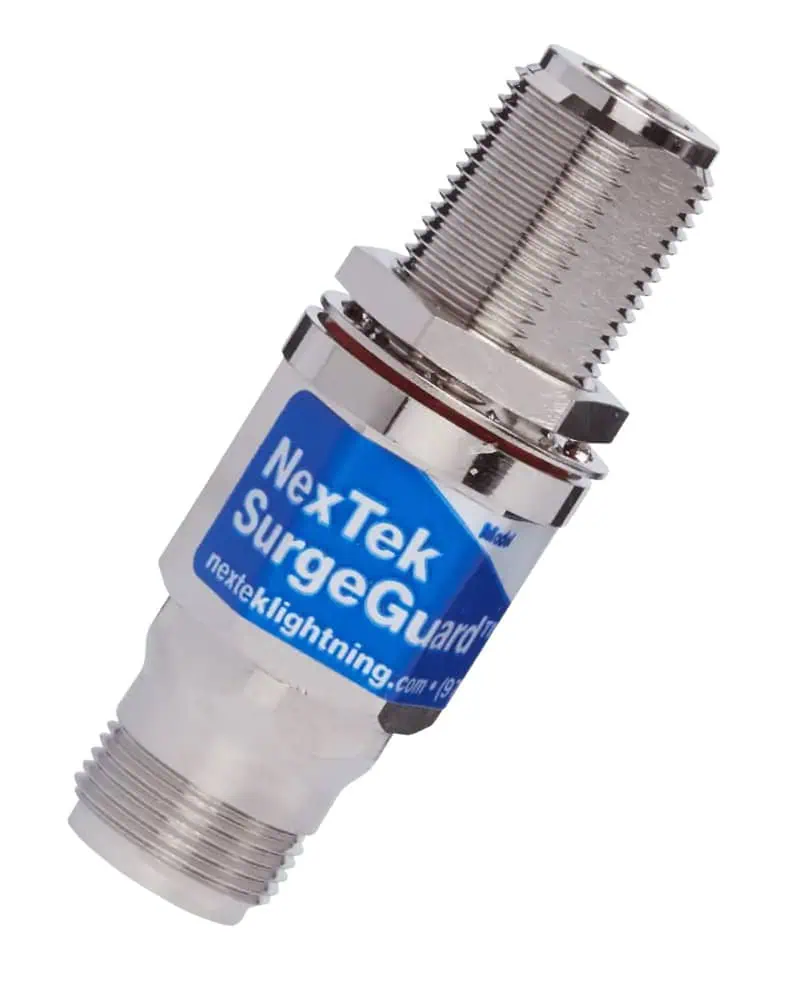
NexTek lightning arrestors are designed to protect multi-constellation and multi-frequency receivers operating across critical L-band frequencies. These solutions deliver robust surge handling with very low let-through voltage, helping safeguard sensitive RF front ends without degrading signal integrity.
NexTek Gas Discharge Tube arrestors provide reliable bi-directional protection and are available in compact PTC series designs for space-constrained installations. For applications requiring extended service life, PTR series arrestors feature replaceable elements that support wideband performance and simplified maintenance.
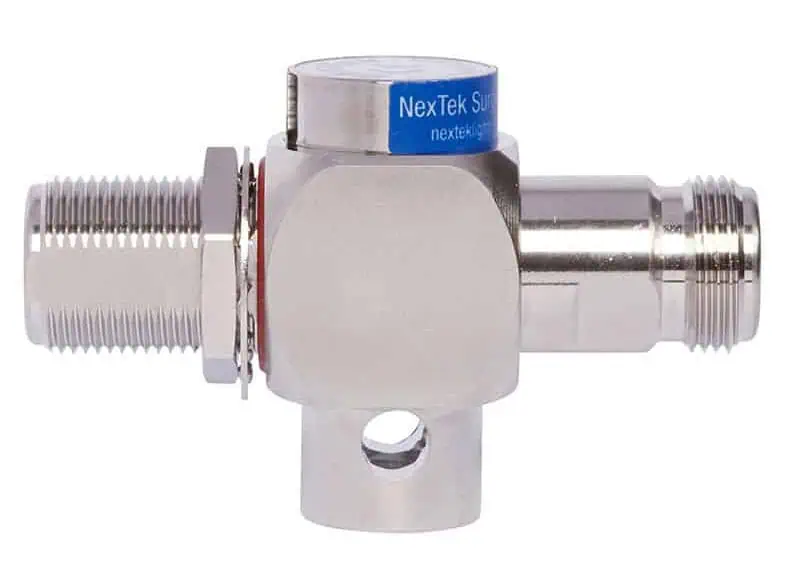
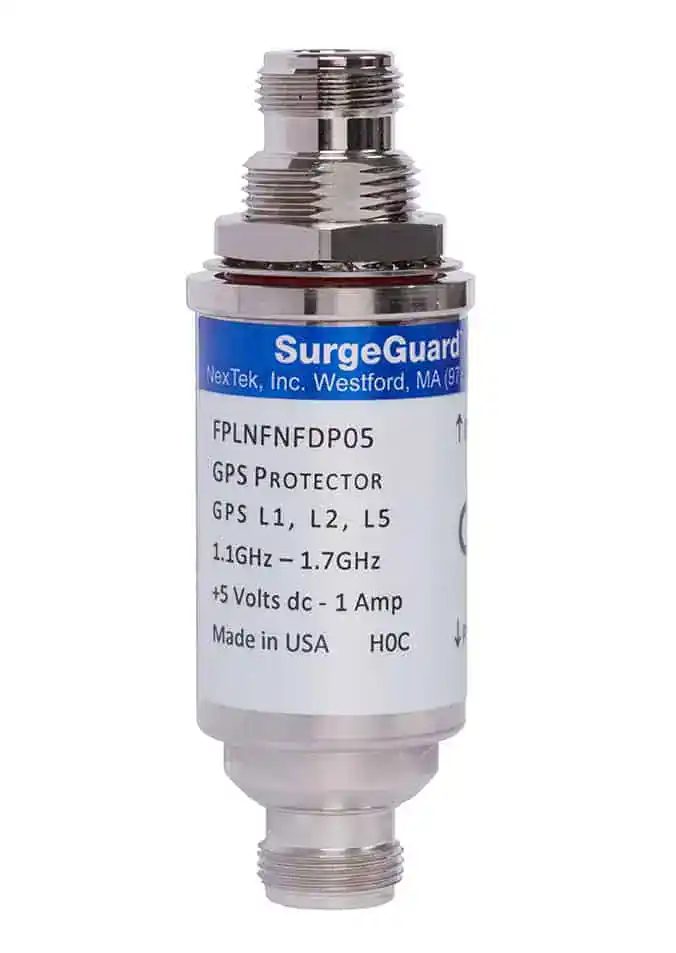
For the most demanding installations, NexTek hybrid surge arrestors combine multiple technologies within a multi-stage design. This approach enables fine protection for highly sensitive receivers while maintaining DC pass functionality to power active antennas — a key requirement in many high-precision GPS deployments.
By aligning SPD technology with application requirements, NexTek helps engineers implement effective GPS lightning protection without compromising RF performance.
Securing the Future of High-Precision Applications

As GNSS technology continues to advance, the need for dependable surge protection becomes increasingly critical. High-precision systems are now embedded in autonomous vehicles, smart infrastructure, industrial control networks, and next-generation communication systems.
Because these applications demand uninterrupted positioning and timing accuracy, protecting sensitive RF modules from lightning and transient events is imperative for any new design. Through strategic SPD placement, proper grounding practices, and application-specific surge arrestor selection, engineers can significantly reduce downtime risk and extend equipment life. With purpose-built coaxial surge protection solutions designed for L-band performance, NexTek enables engineers to safeguard high-value GNSS systems against unpredictable surge events while preserving the precision those systems were designed to deliver.
To explore the full range of GPS/GNSS surge protection solutions at NexTek and identify the right coaxial surge arrestor for your next design, visit our GPS/GNSS solutions page or connect with a NexTek applications engineer.
More Company News



Get A Free Quote
Or Call 978-486-0582